Category Archives: Uncategorized

The fear of COVID-19 is far from over. Still, with inoculations in progress and new virus strains, business organisations globally are pursuing to figure out the best ways of return to work in the post-pandemic world. With COVID-19 having brought unprecedented humanitarian challenges, it is evident that we cannot go back to the way we did things in a pre-COVID world.

Organisations are putting the lessons learnt over the past year to best use to reimagine workplaces. Concentrating on creating safe and enjoyable workplaces will ensure productivity and nurture talent within organisations.

While there is no one-size-fits-all solution, the need of the hour is exceptional change-management skills with empathy as a cornerstone as employees return to work.

Here are three C’s that can aid the return of employees while advancing the goals and strategies of the organisation.

Collaboration

Since the outbreak of the pandemic, technology has proved to be a strategic and dependable arsenal to build operational agility and scale. Digital collaboration tools ensured utmost efficiency in the remote working environment. Amid the uncertainty of the pandemic, these tools also helped us achieve a semblance of work-life balance.

As we return to office, technology and digital support will continue to play a pivotal role in the workspace of the future. The primary purpose of an organisation in this next normal is to permeate a culture of collaboration and build greater resilience. They will achieve this goal by combining the efficiency of collaborative tools with the effectiveness of in-person interactions.

Commitment to health and safety

The health and safety of employees can be second to none. Companies need to build and communicate clear strategies about the return to work with a fact-based approach as a trust-building exercise.

The key to this exercise may be to disseminate clear compliance with standard operating procedures as per the local authorities’ rules. Ensuring health and safety issues by making shift adjustments, providing social distancing and sanitisation of on-site employees and encouraging or facilitating vaccinations for all are positive measures.

Finally, it is imperative to have a contingency plan for medical support or hospitalisation if there are positive cases despite preventive measures.

Communication with courage

COVID-19 has taken a toll on the mental health of employees worldwide. While the anxieties and uncertainties will take time to overcome, the onus is to engage and strengthen overall connections with employees recognising and addressing their fears.

Clear and inspiring communication by leaders and senior management alongside simultaneous team building or upskilling activities may help employees make a transition into a new world. The key is to assure employees that we are all in it together – acknowledge and accept the changes of the year gone by, make the requisite transition and finally be hopeful and look towards a brighter future.

COVID-19 has created an unprecedented upheaval in our personal and professional lives. In this transitionary phase, employees returning to work can be a powerful source of motivation. Future ready organisations are walking the extra mile in creating a reassuring and familiar environment.

Living amid constant uncertainty for more than a year has taken a toll on us. The direct and indirect impact of the pandemic continues to linger on. According to the Work Trend Index report by Microsoft last year, about one-third of employees in organisations from Asia-Pacific reported symptoms of burnout1. Unlike typical burnout, this exhaustion is a symptom of what has been termed as ‘pandemic fatigue’, a lesser discussed but prevalent effect of COVID-19.

The long-drawn pandemic has impacted society and the economy alike. As more people get vaccinated, the overall situation seems to be swaying in our favour, and activities will steadily return to normal. Humans have an inherent survival instinct that keeps us going. We may pause in pursuit, but we never stop in defeat.

Here are some ways to help each other keep the morale high at work in the changing normal:

1. Check in on colleagues

‘Well-being’ and ‘belonging’ ranked as the top two of Deloitte’s Global Human Capital Trends in 2020, with 80 per cent and 79 per cent of organisations, respectively, considering them fundamental2. This is an encouraging indication that global business communities are acknowledging the value of human connections in the workplace and their effects on the way people work.

Instead of limiting all interactions to work-related matters, take a moment to check in on your friends and colleagues. Someone’s family member may be battling COVID-19, or someone may be anxious about the future. Knowing the behind-the-scenes of one’s moods and being aware of a colleague’s mental state helps develop empathy among team members. This, in turn, maintains our collective morale.

2. Prioritise health and wellness

A McKinsey survey revealed that compared to respondents who were dissatisfied with their organisation’s COVID response, those who were satisfied are four times more likely to be engaged at work and six times more likely to report a positive state of well-being3. It shows that the way organisations have been responding has a tangible impact on employees. Physical, mental and emotional well-being must be the top priority for everyone – the organisation’s responsibility towards its employees and of employees towards each other.

Remember to ease into the day instead of diving into a flurry of activity immediately after waking up. Listen to relaxing music, meditate or do any activity that calms you. This will help you to focus better when you’re working. For physical health, you can do some brief indoor exercises like chair squats and calf raises. Give yourself a break from the screen and desk every 45 minutes and take short walks. Holistic well-being makes work more satisfying.

3. Celebrate achievements

In these exceptional times, we should be more openly appreciative of each other’s achievements, big or small. Even milestones that may have felt minor in pre-COVID times are significant today, simply because we are achieving them despite the additional stress we’re experiencing.

Express gratitude and give a shout-out to colleagues that you wouldn’t have otherwise. Be more verbal with appreciation even for small efforts. Such little actions go a long way in boosting morale and building a culture of optimism and respect for each other.

4. Have some fun

Fun is probably the last thing on people’s minds these days as they struggle with a range of emotions like fear, anxiety and confusion. But it has been observed that when a shut-in family engages in games, music or dance, it helps them manage unpleasant feelings better. Similarly, engaging in light activities like games, karaoke and quizzes, is a great way for workers to feel a sense of normalcy.

Such activities have been proven to instill a sense of camaraderie among employees and strengthen their bond. In this pandemic, part of our problems is physical and part psychological. While the former will be overcome in due course of time, we can choose to end the latter through sheer force of will. So, participate in light activities and lift each other’s spirits together.

As communities, businesses, institutions and governments continue the fight against COVID-19, we may feel the need to be stoic, but we must not lose touch with our emotional side. Continue to act in a realistic manner, but also be optimistic in your thoughts. Exercise caution without compromising on compassion. We are in this together, and togetherness will get us out of it.

The need for organisations and business leaders to tap into their emotional quotient (EQ) has never been as important as it is today. The world has been witnessing unprecedented circumstances for more than a year. It has been a mentally challenging time for people and requires businesses to manage emotions along with the enterprise. While agile business practices helped enterprises navigate the erratic reality of lockdowns, fresh waves of COVID-19 and unlock cycles, human capital needs support at a different level to ensure well-being.

Across OECD countries, the prevalence of anxiety and depression has increased significantly in 2020 compared to previous years1. Further, a survey from the United States Centers for Disease Control and Prevention2 found that 40 per cent of American workers reported a decline in mental health during the pandemic. Of these, 40 per cent said no one from their workplace had called to check up on them. And out of the people who hadn’t been checked on, 38 per cent had a higher likelihood of reporting that they were not doing well.

It is difficult enough to establish a bond between team members during normal times, which is made tougher in these times of social distancing and masked faces. These are also the times when people need to be more emotionally available for each other, whether it is supporting someone through a personal loss, discussing the strangeness of our current shared reality or helping to relieve someone’s anxiety.

It’s no surprise then, that managers and co-workers need to be more emotionally available to each other. EQ has become an important trait that leaders need to possess, besides IQ. Building an emotionally intelligent workforce needs both top-to-bottom and bottom-to-top approaches.

Here are some points to know about creating a work culture in which co-workers are more holistically in sync with each other. It’s a culture in which one’s analytical and empathetic sides are encouraged to work in synergy to guide the organisation to the other side of the pandemic.

Introspection

EQ, or emotional intelligence, is a person’s ability to sense, identify and manage their emotions and those of the people around them. Being aware of others’ emotions starts with being conscious about your own emotions. It involves being mindful of how your moods and actions can affect you and the people you work with. This requires taking a step back and observing how we interact with co-workers and react to the various situations we find ourselves in as part of our job.

Self-aware individuals are more in touch with their strengths and weaknesses. They have a better sense of how others view them, are more skilled at giving and receiving feedback and are more approachable. Also, most importantly, they lead by example.

Emotional agility

It’s a given that work requires us to be analytical. But when it comes to managing people, knowing about the things that drive them and what demotivates them is a handy skill. Emotionally intelligent people make the best use of this capability. They can switch between their empathic and analytical modes at will and speed.

It sounds like an impossible thing to do, but one can develop this emotional agility with practice. People who identify as more analytical at work will benefit from making a conscious effort to tap into their emotional side. It can be as simple as a casual conversation with a colleague where your only objective is to understand that person. On the other hand, people who identify as more of the emotional type can set specific periods in a day of complete focus and dedication to a task with an objective mindset.

Emotional agility is about being able to switch between one’s analytical and empathic sides as per the given situation—balancing the mind and heart, the problem-solver and the listener-empath.

Listening

When someone shares a problem with us, we often feel the need to respond with a solution. However, as counterintuitive as it sounds, when people talk about their problems, most of the time they’re not seeking a solution. All they want is a sympathetic ear and someone to simply listen to them.

For this to work, you have to listen to them with your full attention. That means no checking emails or no fidgeting on your phone. Listening is not just hearing someone’s words but also observing the inflections in their voice, gestures and the parts where they pause or sigh. Listening fosters a sense of belonging and gives out a clear unspoken message to people that they matter. It is also the most vital skill needed to truly empathise with the people we work with daily.

A series of studies done by the Stanford School of Business on emotional acknowledgement in the workplace3 revealed that emotional acknowledgement led to higher evaluations of trust.

Empathy

This word has regularly featured in business communication ever since COVID-19 became a pandemic. Leaders, organisations and institutions have been talking about and practising empathy. According to Businessolver’s sixth annual State of Workplace Empathy study4, 72 per cent of employees rated their organisations as empathetic in 2021—four percentage points higher than the previous year.

It is important to understand the types of empathy and how we can use it in the workplace. The two types of empathy are cognitive and emotional. The former has to do with putting yourself in someone’s shoes and understanding their position. The latter is about feeling the pinch of the shoes as well.

Cognitive empathy is getting a perspective of another’s situation, and there are no downsides to it. Emotional empathy, however, can affect the empathiser unpleasantly if they have the tendency to become overwhelmed by emotions. This can create a new set of problems as too much empathy may result in stress or burnout. This, of course, does not mean that emotional empathy is a bad quality, just that excess of it might be harmful. This takes us back to what we covered under the first sub-topic of introspection and managing one’s own emotions before reaching out to others.

Overall, a healthy balance of IQ and EQ is the best way to be mentally equipped to manage yourself and others at the workplace. It’s about knowing how you react to situations, how you are perceived and how you can find meaning at work, along with strengthening your relationships with your co-workers and the organisation.

The pandemic is a one-of-a-kind challenge that has impacted every aspect of our lives – be it professional, leisure or personal. The corporate world too has witnessed a series of disruptions that required businesses to rethink everything from processes, policies and traditional workspaces. The changes created new challenges like a widening skill gap but have also presented opportunities to adapt to new business models and equip the workforce with the relevant skills.

Why do we need to upskill?

The pandemic resulted in accelerated digital transformation, remote work and innovation in operations, collaboration and communication – all at the same time. The conventional ways of working are already obsolete and traditional skills will phase out soon. We need to upskill our workforce so that they remain resilient in the face of unexpected situations and have the ability to deliver new business models.

Individuals with the right and relevant skills will be in a better position to participate in the post-pandemic economy. Upskilling allows them to leverage their talent to create real value for themselves and others. It is time for business leaders to devise workforce strategies that focus on upskilling. This will enable organisations to adapt to the new normal of the future, take advantage of advancements in technology and remain competitive in the post-pandemic world.

How do we upskill?

Writer and futurist Alvin Toffler said, “The illiterate of the 21st century will not be those who cannot read and write, but those who cannot learn, unlearn and relearn.” In today’s competitive landscape, mere learning is not enough for growth. We have to develop a mindset of ‘unlearn, learn, relearn’.

Professionals of all ages and experience levels must be prepared to gain knowledge and new skills, discard old processes and information and learn what we know again in the evolving circumstances. Upskilling effectively involves being curious and challenging our beliefs and assumptions to gain cutting-edge skills and adapt to the new.

Traditional businesses are going digital. They are transitioning to digital operations to respond to evolving customer needs, offer consistent customer experience, unlock productivity and manage scale. Upskilling the workforce is a critical success factor in this digital transformation.

Organisations need to develop a holistic talent plan for employee skill development. A successful strategy will provide depth to the existing skill set of the workforce and empower them to embrace opportunities in a way that adds value to the organisation and their employability. Skilling programs that impart technical skills and digital literacy will go a long way in driving organisational success and providing economic mobility to employees.

Upskilling is a strategic lever for businesses to adapt to the post-pandemic world by preparing their employees for it. Organisations need to adopt a multi-pronged approach to reskill and upskill. Learning & development teams will have to develop a comprehensive skilling program that ensures cross-training, development of soft skills, cognitive skills and imparts digital and technical skills.

Companies that implement innovative learning approaches will achieve their skilling goals better and faster. Apart from in-house training sessions and self-learning courses, newer learning methods such as social learning and personalised content delivery must be incorporated. Organisations can collaborate with educational institutions for niche skills. Another way is to provide specific work-related training and modular, less structured and smaller pieces of training.

Upskilling tips for professionals

Many professionals took the opportunity to improve their digital skills over the last year. The current business environment and rapid digital transformation demand new capabilities from employees, so they must move forward on their skilling journey.

Workers across industries must figure out how they can adapt to changing business scenarios and equip themselves to match present and future roles and activities. Individuals must be proactive in gaining in-demand knowledge and skills. It’s a good practice to create a skill map of what will be in demand in the future and how one can acquire those skills.

Acquiring skills required in the present and future helps employees remain relevant in their organisation and industry. It also arms them with the appropriate tools for upcoming opportunities and challenges. In addition to future-proofing themselves, they can advance in their career and steer their organisation towards success in the post-pandemic world.

Organisations have to develop critical workforce capabilities so that employees and organisations both become resilient and emerge stronger on the other side of the pandemic.

The United Nation celebrates World Environment Day on June 5 every year. It’s an opportunity to encourage worldwide awareness and action to preserve our environment. At AM International, we believe ecological mindfulness is a critical business responsibility, and the conservation of natural resources is key to our manufacturing competitiveness.

This year also marks the beginning of the ‘UN Decade on Ecosystem Restoration’ (2021-2030). The decade will focus on preventing, halting and reversing the damage to ecosystems. It marks the transition to healing the planet. The global movement will include reviving billions of hectares, from forests to farmlands, from the top of mountains to the depth of the sea. Fittingly, the theme for World Environment Day 2021 is ecosystem restoration, and its theme is “Reimagine. Recreate. Restore.”

The group companies of AM International celebrate World Environment Day every year by hosting drives to plant trees and activities that spread awareness. We also realise that protecting the planet is a year-round responsibility that requires consistent efforts. Hence, our teams work persistently to integrate sustainability into our plant processes and business practices. The group companies at AM International are committed to:

  • continually improve operations to reduce our average impact on the environment
  • minimise waste generation and maximise recovery and recycling efforts
  • comply with the region’s environmental legislation and regulations
  • create environmental awareness among customers, employees, suppliers, and the community

AM International’s environmental goals in action

Switching to alternate energy and recyclable resources is an essential aspect of our efforts to build a sustainable future for the planet. We are actively working to reduce our greenhouse gas emissions and do our bit to combat global warming and protect the environment.

Here’s a look at some of the initiatives by our group companies that take AM International closer to our environmental goals:

Southern Petrochemical Industries Corporation Ltd

Our flagship company, Southern Petrochemical Industries Corporation (SPIC), follows several measures to monitor and control pollution to minimise the impact of its activities on the environment. The recent commission of a direct pipeline from Oil and Natural Gas Corporation (ONGC)’s facility at its Tuticorin factory in Tamil Nadu enabled SPIC to enter the Natural Gas era. Being a green fuel, this development bolsters the company’s efforts to adopt environment-friendly practices. It is a critical step in SPIC’s progress to green and modern manufacturing. The company’s other measures include renewing the urea plant reactor, online monitoring of ammonia and particulate matter in the urea prilling tower, installing effluent quality monitoring system, online monitoring of ammonia plant-reformer flue gas stack Nitrogen Dioxide (NO2) analyser and optimising the steam network.

Manali Petrochemicals

Manali Petrochemicals (MPL) has eliminated the use of fresh water in its manufacturing processes. Instead, the company uses 100 per cent treated sewage water. The switch helps MPL to reduce water wastage which ultimately contributes to the company’s objective of optimal water management. The company is also moving towards the use of Liquified Natural Gas (LNG) in all its processes to lower the environmental impact of combustion. MPL has also taken the responsibility to create a green belt in the industrial area around its Plant-1 to mitigate the effects of industrial activity.

Tamilnadu Petroproducts

Tamilnadu Petroproducts (TPL) is equipped with a waste air de-chlorination system that absorbs released chlorine and prevents chlorine emission into the environment. The company uses recycled water from the Tertiary Treated Reverse Osmosis (TTRO) plant and from its in-house Reverse Osmosis (RO) plant to encourage freshwater conservation. Over the last two years, the company has made conscious choices to invest in cleaner fuel to enhance the plants’ eco-efficiency. Some examples include switching from fuel oil to LNG, atomising steam reduction in the furnace and improving heater efficiency.

Tuticorin Alkali Chemicals & Fertilisers

Tuticorin Alkali Chemicals & Fertilisers (TFL) is the first and only company to have installed a carbon capture unit to manufacture soda ash. The installation allows TFL to recover Carbon dioxide (CO2), harmful greenhouse gas and convert it to soda ash which is then supplied to global customers. The unique and pioneering process can capture and process up to 60,000 MT of CO2 that would otherwise have been emitted into the atmosphere. In 2020, TFL won the ‘Partnership of the Year’ Award from Unilever for supporting its clean future agenda in South India.

Greenam Energy

Greenam Energy is committed to introducing new-age technologies that optimise sustainable and green energy production norms. The company is installing a 24 MW floating solar power plant, one of the first in India. Once completed, the project will fulfil SPIC’s electricity needs, and the surplus will be supplied to state power utilities. Spread over 62 acres, the project is expected to reduce CO2 emissions to the tune of 50 million kg per annum. Simultaneously, it will save freshwater evaporation up to 100 million gallons per annum from SPIC’s raw water reservoirs.

All of us at AM International recognise that today’s intentional actions will enable our businesses to be future-ready and contribute to a better world tomorrow. A robust and practical framework for sustainability is vital in this context. The strategy will be integral to create new-age opportunities, continually improve our operational performance and positively impact the entire stakeholder value chain.

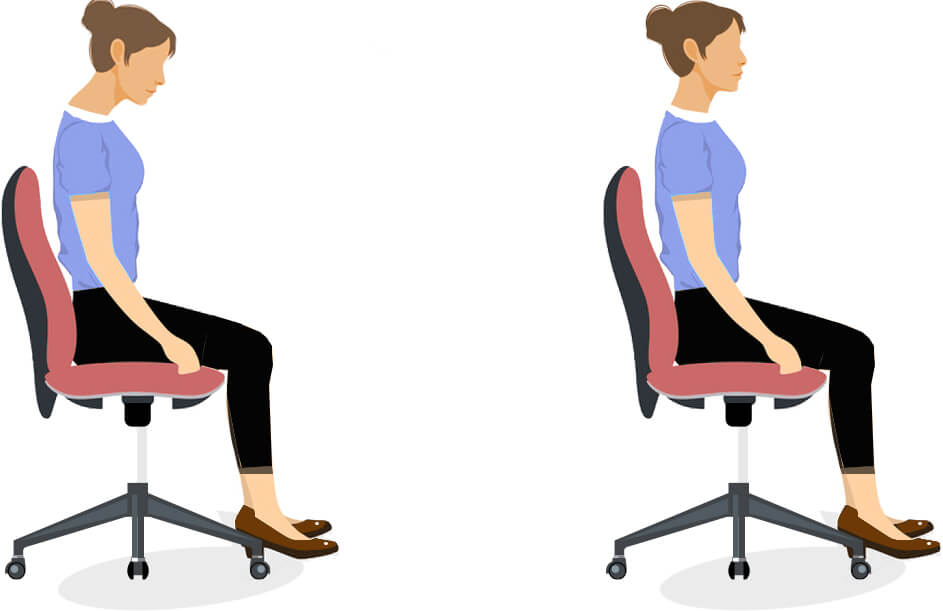
Most of us spend the majority of our day at our desks, hunched over the laptop. Working from home has further reduced our movement. Sitting at a desk certainly makes one focus better and be more productive at work, but it may lead to several health concerns in the long run.

Sure, we may begin the day with the correct posture but one stressful email and we’ve forgotten all about sitting right. Besides, sitting continuously for long hours can reduce blood flow to the legs, lead to chronic back issues, neck pain and even obesity. Now more than ever, it’s become important to incorporate some fitness hacks into our daily schedule.

All you have to do is rethink how you can optimise your workspace for a quick workout. Here are some quick and easy exercises to get you started. You can easily do them at your desk or around it. Don’t worry about making extra time. You can easily do them while waiting for a large file to download or when you’re waiting for your colleagues to join you for a meeting.

The exercises give you an excuse to take a break from work and move around a little without taking you away from your to-do list for too long. It’s a good way to prevent mental fatigue and reduce the chances of aches and pains.

From the comfort of your chair

NECK STRETCHES

  • Sit comfortably in your chair.
  • Look up towards the ceiling.
  • Hold the position for 10-15 seconds or till you feel a stretch.
  • Lower your chin to your chest. Make sure to keep your shoulders nice and straight.
  • Hold the position for 10-15 seconds.
  • Repeat five times.

NECK STRETCHES


HANDS STRETCHES

  • Clasp your hands together and hold your arms out straight in front of you with your palms facing forward.
  • Keep your back straight and stretch out your hands.
  • Hold the position for 10-15 seconds.
  • Repeat, but this time with your arms behind you and parallel to the floor.
  • Repeat five times.

HANDS STRETCHES


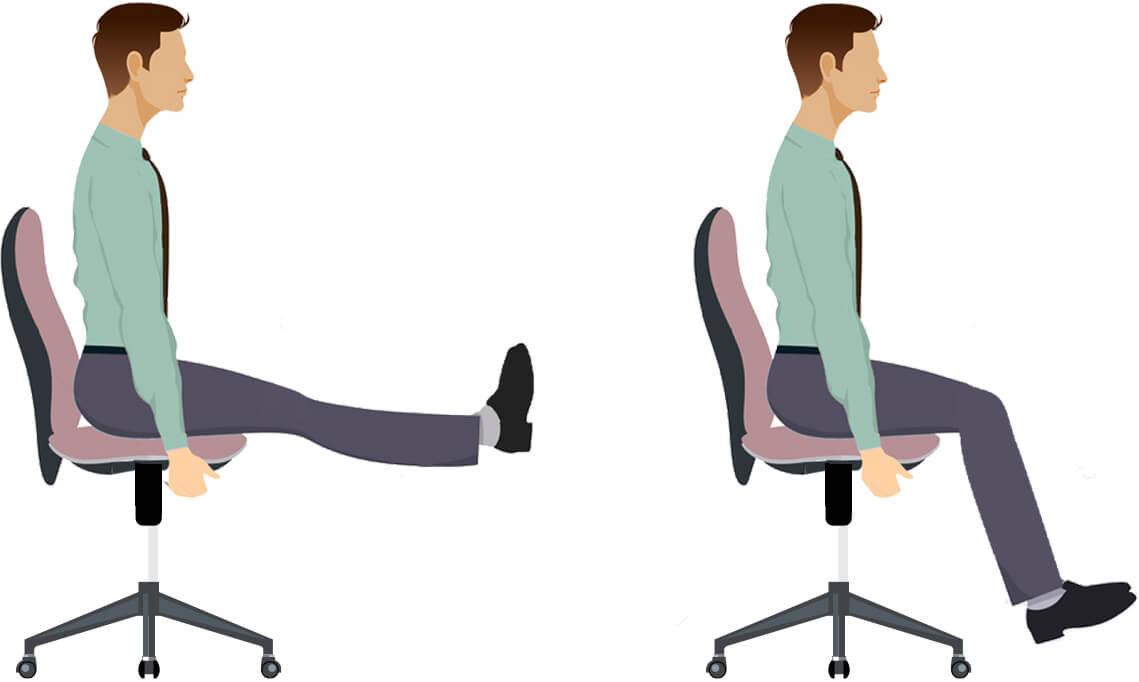
LEGS STRETCHES

  • Keep your arms by your sides.
  • Extend your legs out straight, parallel to the floor and with your toes pointing to the ceiling.
  • Flex your feet towards your body.
  • Hold the position for about 10 seconds.
  • Put your legs down slowly.
  • Repeat five times.

LEGS STRETCHES


Get on your feet!

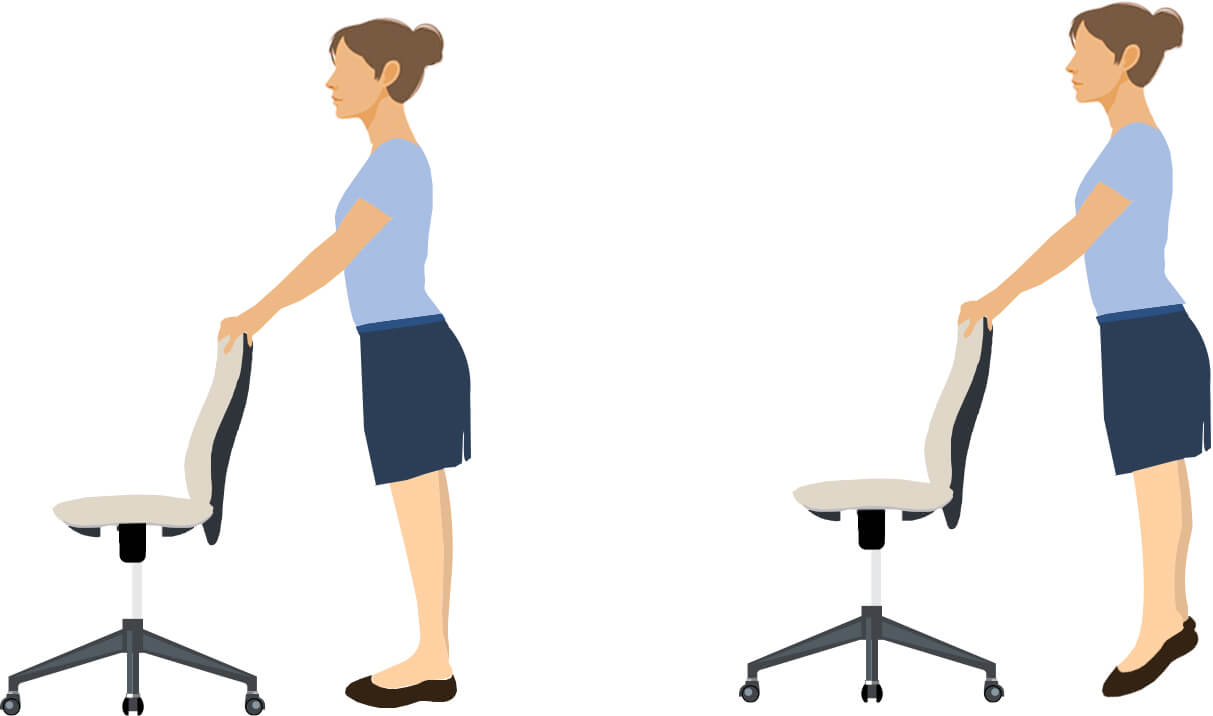
CALF RAISES

  • Stand behind your chair and hold it for support.
  • Raise your heels off the floor until you are standing on your toes.
  • Keep the position till you feel a stretch on your feet and calves.
  • Slowly lower yourself back to the floor.
  • Do this about 8-10 times.

CALF RAISES


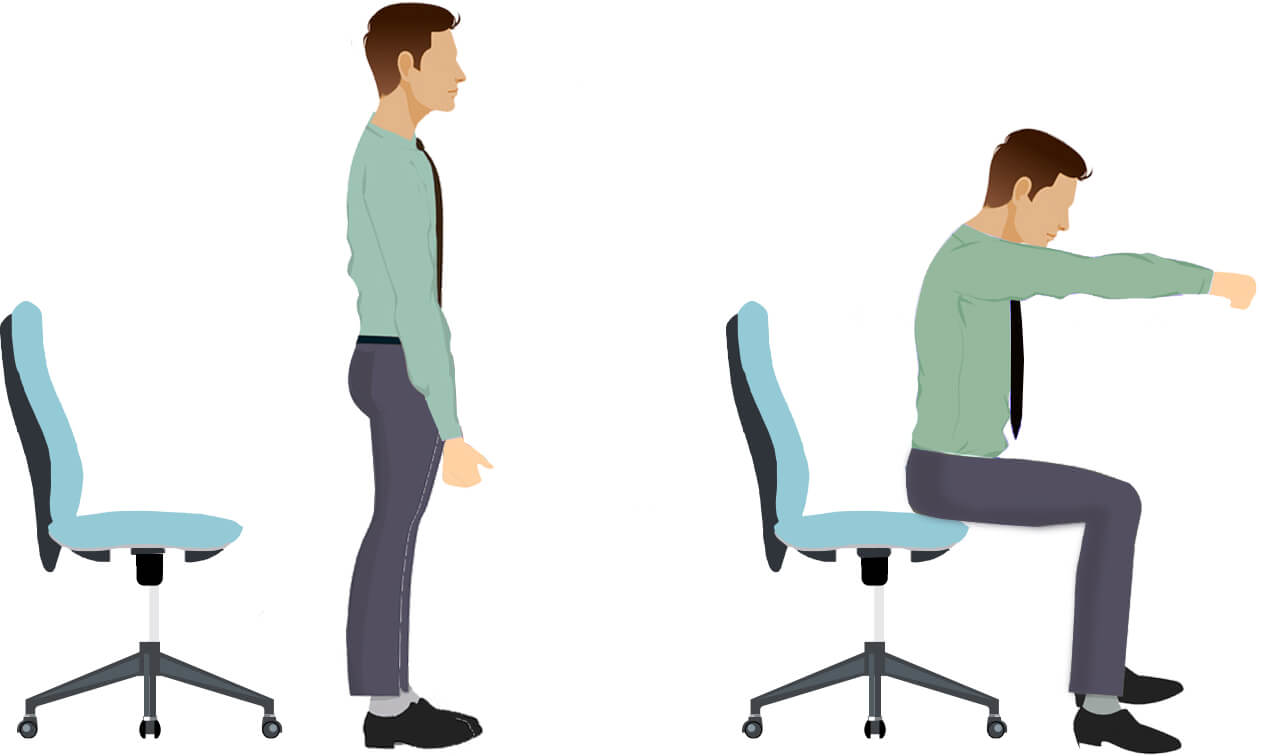
SQUATS

  • Stand up and stretch out your hands in front of you, parallel to the floor.
  • Lower yourself by bending your knees until your thighs brush the seat.
  • Remember to keep your back straight.
  • Hold for a few seconds.
  • Go back to the standing position.
  • Repeat 8-10 times.

SQUATS


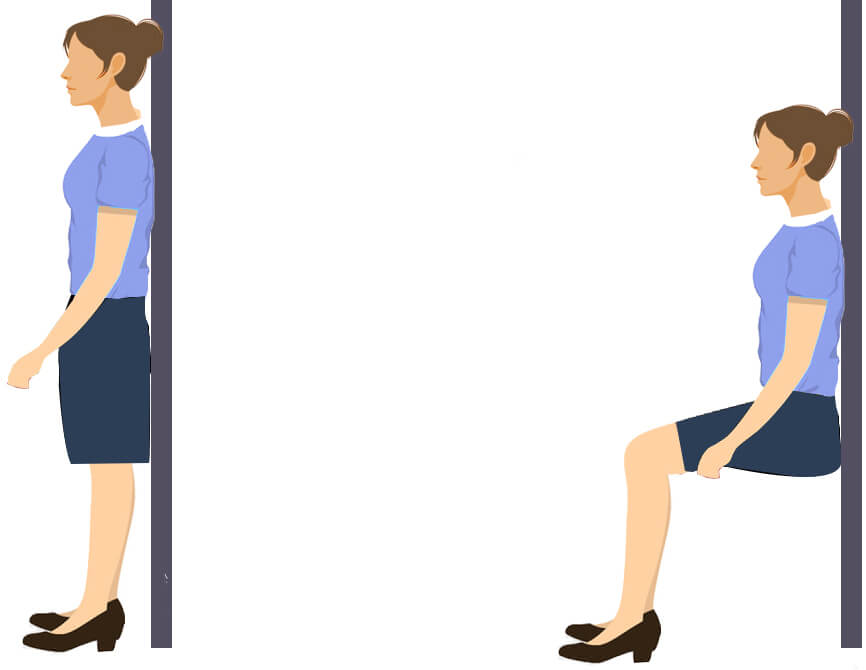
WALL SITS

  • Stand against a wall so that your back is flat against it and your heels are on the ground.
  • Lower your body till your knees are bent at 90 degrees to be in a sitting position.
  • Hold the pose for 10-30 seconds. Stand up slowly.
  • Repeat 5-10 times.

WALL SITS


Make sure you remember to do these quick exercises during your workday. If you’re prone to forget, set a daily reminder. While nothing can replace a regular exercise routine for a healthy body and mind, these fitness hacks keep you moving and your blood pumping. Keep them handy for the weeks when you can’t find the time for a full-fledged workout.

We responded remarkably well to the new work-life routine demanded by the pandemic in 2020. With operations gradually returning to the physical workplace, there’s yet another different normal to adapt to.

As an employee, you have to realign to a changed way of working yet again. After so many months of working remotely, returning to work will not be the same as merely returning to the work environment after a regular break.

There are some changes we may have to start mentally preparing for. Catching up with colleagues over coffee in the pantry, for example, or sharing food may not be advisable now. There may be other concerns and new challenges like the fear of being in the close vicinity of others and additional responsibilities like caregiving at home, which may not be possible when you resume working in the office.

What can you do to transition seamlessly to the new way of work?

After finally settling into work-from-home, changing your routine once again may feel cumbersome, but it’s the reality of the times we live in. To ensure uninterrupted productivity despite the constant changes around you, here are a few habits to develop:

Upskill and reskill yourself

All of us leveraged the lockdown limbo to acquire many new skills in 2020. From working with co-workers remotely to learning flexibility and resilience in the face of new challenges and issues in our routine. Many of us developed soft skills like compassion and empathy, usually reserved for loved ones, towards our colleagues.

The pandemic-led increasing dependence on digital tools has accelerated the need for specialist digital skills, social intelligence skills and innovation. Equip yourself with these skills to set yourself on the path to success.

Share your ‘home learnings’ with colleagues:

When you’re back at work, you can talk about the new work practices you followed while working from home, which helped you improve performance and productivity. It can lead to a valuable exchange of ideas between colleagues, managers and HR. Work together to develop strategies that can help implement these ideas in the traditional workplace.

Be open in your communication

Some of you may not be able to commute the same way as before. Others may have apprehensions about using public transport. Don’t hesitate to voice your commute concerns to your workplace so that the organisation can take steps to accommodate your needs.

Remember to continue following the public health safety practices as mandated by the government and your organization – you and your colleagues can continue working in the office safely.

Continue taking care of your physical & mental well-being:

Working from home may have allowed us to sneak in a run between meetings, but that may no longer be possible once we return to the office. Make sure to take out time for physical fitness even after resuming going to the workplace.

The constant and sometimes unexpected changes can be overwhelming. It’s normal to experience a drop in productivity and lose focus quickly on some days. Remember to take regular breaks when you’re working from the office. Mindful meditation for a few minutes at your desk or practising the Pomodoro technique are some ways that can help.

We are social beings

The pandemic has resulted in circumstances that can often lead to loneliness and anxiety. We may need to maintain physical distancing, but it doesn’t have to become social. You can still connect with people virtually.

As more communities open up, take the time to meet your family and friends in pandemic-approved social settings. Talk with people you trust about your feelings and concerns. Check on others and help them. These steps help to improve your self-esteem and give you a sense of belonging.

Plan for the future. Humanity will overcome this crisis too. Be hopeful and set goals for personal growth and professional development. Goals give one a sense of purpose and something to look forward to. Plan experiences that will make you smile.

The new phase is an opportunity for us to reflect on the past and renew our mindset. Doing this helps us to unlock our potential and improve overall performance.

Wishing you Happy & Safe Working. Welcome back to your office!

What makes a seemingly ordinary next-door boy a legend?

What takes a person from the obscurity of his origins and puts him on a pedestal at par with divinity?

Mahendra Singh Dhoni (M.S. Dhoni) – whenever we hear the name, a broad smile comes to the faces of crores of Indians. Known as ‘Captain Cool’ of the Indian cricket team, M.S. Dhoni has been an exceptional cricketer. He is someone that everyone looked up to when there was no ray of hope at the end of the tunnel. His journey holds many lessons that we can learn from and integrate into our professional lives.

Here’s a look at some of the lessons:

Captain COOL

M.S. Dhoni is known for his patience. He never gives up on a match and fights until the very end. All eyes went straight to M.S. Dhoni when Team India was under pressure and in a nail-biting situation. The tide could turn on any side. One glance at him and everyone is filled with hope, thanks to his relaxed demeanour. His calm and composed nature, even during tense situations, is what makes him one of the best cricketers of our times.

In today’s fast-paced world, staying calm is important to prevent work-related stress from getting the better of you.

Determined to the core

Not having a foreign education or any exposure to higher education from a private school, M.S. Dhoni’s determination and grit led him to success. It was not an overnight achievement. Years of rigorous hard work and relentless practice made him a legend. Life threw various curveballs at him, but his firm and resolute character always stood him in good stead and took him forward in his journey.

In our professional lives too, resolve and determination are critical to achieve long-term goals.

Solutions-driven

M.S. Dhoni always believed in finding a way out of a challenging situation. His unique and famous “helicopter shot” took everyone by surprise when he used it against England in 2006 during a One Day International (ODI) match. It teaches us how to hit our problems out of the park whenever life throws us a full-length delivery.

By being solution-oriented, we not only solve problems, but also identify the root of a problem and look at a better way of doing things.

A humble leader

Leading a team from the front is not an easy task. It needs strong leadership skills to guide the team towards victory. More than a leader, M. S. Dhoni has been a team player. No matter what the situation, personal or professional, every member looked at M.S. Dhoni for support and direction. He was always there for them. They knew he would provide a reality check without any arrogance or condescendence, but with humility.

Humility is a must for professional success and ensures that you are open to continuous learning.

True to his roots

Many of us get carried away when we achieve success. Some become arrogant, some overconfident, and some detached. We can learn from M.S. Dhoni how to stay grounded and remain true to our roots. Within his inner circle, he is still in touch with old friends who supported him in his early days. He remained loyal to those who were there with him through thick and thin. Like many others, he could have succumbed to peer pressure and lost focus, but M.S. Dhoni chose to stay simple and straightforward. After all, why pretend to be something we are not!

Presence of mind

Keeping the mind at peace when chaos is looming around the corner is a difficult task. It’s one thing to stay calm, a whole different challenge to choose the right direction while remaining calm. M.S. Dhoni always analysed the situation calmly and took conscious decisions while things around him were changing at a supersonic speed. His presence of mind led the team to achieve great victories.

Quick thinking and decision-making are key qualities that each one of us needs to cultivate, especially at a time when data and information overload can numb us to indecisiveness.

These are some of the character traits that represent M.S. Dhoni. Being an anchor to the team during unpredictable times, he proved resilience, which we all can imbibe during these challenging times. While Captain Cool’s retirement from international cricket has left a void in the world of cricket, learnings from his career will continue to inspire many.

Do you see an M.S. Dhoni in you?

The disruptions brought about by COVID-19 have highlighted the significance of domestic supply chains. This means localised development, manufacturing, and distribution. In India, Prime Minister Narendra Modi’s clarion call for an ‘Atmanirbhar Bharat’ (self-reliant India) is aimed at catalysing the country’s progress by strengthening local value chains and boosting innovation.

From agriculture, petrochemicals and green energy solutions to automotive and technology industries, the initiative augurs well for the domestic development of world-class products and services. Now more than ever, India Inc. can catapult its growth trajectory with a focus on self-reliance.

Accelerating the growth of India Inc.

The ‘Vocal for local’ and ‘Local for global’ initiatives will boost the consumer demand for ‘Made in India’ products and services. It will also drive Indian brands to ‘Make for the World’. Government policies on the five pillars of self-reliance – economy, infrastructure, system, demography, and demand – will augment stakeholders across the supply chain.

Let us take a look at the ways in which the vision of an ‘Atmanirbhar Bharat’ is driving change:

Localisation nurturing R&D and innovation

Innovation is the building block of progress. When companies strengthen their R&D efforts and nurture an innovation ecosystem, the scope for growth and employment opportunities increases manifold. Consequently, the two facets of an innovation ecosystem – knowledge economy and commercial economy – will contribute to holistic growth.

The country holds enormous potential to drive these efforts at scale, not just in major fields like agriculture but also in upcoming areas like renewable energy, biotechnology, robotics, and automation. To jumpstart growth across sectors, India needs to intensify state-funded and private sector R&D and make it easy for universities, researchers, and entrepreneurs to be a part of the innovation efforts.

Domestic and home-grown industries getting a fillip

Domestic and home-grown industries can play a pivotal role in realising the goal of a self-reliant India. The ‘Vocal for local’ strategy will create demand for a wide range of products and services offered by Indian brands, thus strengthening the position of domestic companies.

Leveraging the stimulus measures announced by the government, domestic and home-grown organisations will have easy access to loans and grow their business across geographies. Moreover, the initiatives around ‘Digital India’ and ‘Make in India’ will open up incredible opportunities for companies to develop technological solutions for healthcare, education, and other sectors that are now ripe for digitisation.

Building world-class products and services in India

The revised education policy focuses on robust vocational training courses and industry-academia partnerships, thus paving the way for holistic skill development. By channelling energies on skill development and entrepreneurship, India needs to boost job creation and economic activity.

At the academic level, this translates to incubator cells or entrepreneurship cells that hone problem-solving, risk-taking, and creative thinking abilities of students. For India Inc., it provides the pathway to commercialise innovations, by sparking ideas at research labs and taking it to the market. Further, a culture of innovation, when combined with a robust Intellectual Property (IP) framework, motivates talented entrepreneurs to translate their vision into commercially successful products and services.

Reducing imports and conserving foreign exchange

Self-reliance will not only decrease the country’s dependency on imports but also boost the export volumes in the long run. With an enhanced focus on local manufacturing, investments will also flow into exports of finished goods. Subsequently, India Inc. can bridge the widening import-export gaps and position itself as a net exporter.

Emerging stronger as a nation

Along with policy reforms, organisations must leverage the strong demand impetus and a rich talent pool available in India. In the long run, these reforms will ready companies to become globally competitive.

The fight against COVID-19 is a long-drawn battle. As countries across the globe ease lockdown measures and reinvigorate the economy, people are restarting their lives as well. Some of us might have visited our friends and family after months, while others caught up with colleagues at the workplace. Others might have enjoyed shopping at the mall or a sunset stroll by the beach.

As we inch back towards normalcy, it is crucial to understand that now is not the time to lower our guard. Given that living with the virus until vaccines are available is a new reality, we must redouble our precautionary efforts. For the wellbeing of ourselves, our families and communities, here are a few practices we can follow to stay safe:

Wear protective gear

As the adage goes, ‘Prevention is better than cure’. That is why healthcare professionals are advocating the use of personal protective equipment. While stepping out of your home, whether to go to work or to run personal errands, remember to wear face masks, gloves and eyewear. A face mask not only protects you from being infected but also helps you to avoid touching the face after coming in contact with other surfaces.

  • If you are using reusable masks made of cloth, wash and disinfect it after every use.
  • While using a medical-grade face mask, ensure that you replace it with a fresh one once it gets moist. Also, dispose it with caution, following the guidelines issued by authorities.
  • It is also advisable to top up your first line of defence with a face shield.

Practise social distancing

While circuit breaker or lockdown measures are no longer in place, physical distancing is a must. Even without visible symptoms, people around you might still be carriers of the virus. Therefore, as much as possible, avoid close contact with people and maintain a gap of at least two meters (six feet) whenever you are in a public space.

  • While socialising at work or elsewhere, avoid handshakes and opt for no-touch ‘namaste’ greetings instead.
  • Understandably, you might want to throw a party after long or attend one. However, being a part of crowded spaces is an open invitation to infection. That is why it is better to avoid groups of five or more people.
  • At work, maintain physical distancing in your cabin, conference rooms or while walking around the factory shop floor.

Prioritise cleanliness and hygiene

Keeping everything around you clean and disinfected is critical . Continue to maintain hand hygiene, by frequently washing your hands with soap and water. If you are in a public space, use an alcohol-based sanitiser to disinfect your hands at regular intervals, particularly after sneezing, coughing, or touching public surfaces.

  • Disinfect frequently touched surfaces, like tabletops, switches, doorknobs, handles, phones, keyboards, etc.
  • Practise a hygiene routine every time you come back home. For instance, avoid immediate contact with family members and settle down only after thoroughly washing your hands and changing into clean clothes.
  • In case you experience any symptoms, stay back at home and seek medical help. Ignoring the symptoms can lead to the virus affecting your office colleagues, friends, and family.

Boost your immunity

Take care of yourself and boost your immunity , so that your body can fight the virus. Maintain a routine and incorporate exercise and relaxation techniques to your daily schedule. This will help you destress, get good sleep, and strengthen your mind and body.

  • Eat healthy, nutritious, homemade food and avoid junk food and sugary drinks.
  • Keep exercising. Make time for a brisk walk in the park or a run in the park. Make use of online resources to experiment with other forms of exercise, like aerobics, strength training or core strengthening activities.
  • Incorporate micro habits, like taking the stairs instead of the lift or walking a couple of blocks instead of hitching a ride.

Embracing the new normal

The economy is opening up, and governments and local authorities are facilitating a safe transition to the new normal. As we step out of our homes and resume a normal routine, we must bear in mind that the fight against COVID-19 is far from over. Instead of lowering our guard, we must continue to practise precautionary measures.

As Benjamin Franklin puts it, “An ounce of prevention is worth a pound of cure.”